

In today’s fast-paced industrial landscape, efficiency is not just a goal, it’s a necessity. Industrial companies worldwide are constantly seeking ways to optimize their operations, reduce costs, and improve productivity: fabriq, as the leading digital Daily Management System, is one of this kind.
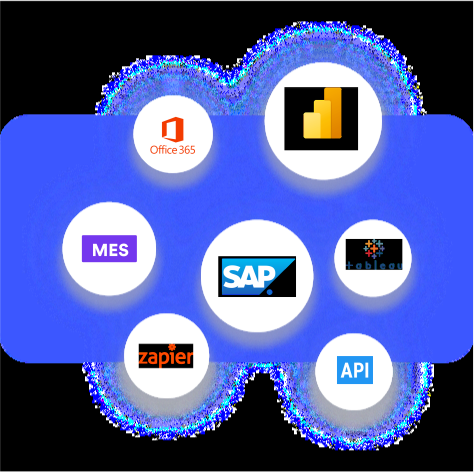
At the heart of fabriq’s benefits lies its integration capabilities with existing manufacturing systems. Through its API, fabriq enables clients to connect their systems effortlessly, empowering them with real-time insights and actionable data. Let’s explore how some companies have leveraged fabriq’s integration capabilities to unlock manufacturing efficiency.
Driving Efficiency: Leveraging API Integration of fabriq with MES and SCADA Systems
For a leading company in the automative manufacturing sector, KPIs (Key Performance Indicators) are not just metrics; they are the cornerstone of their performance management strategy. To bring their vision to life, they turned to fabriq, our industry-leading SaaS solution.
This forward-thinking company seamlessly integrated fabriq with their MES (Manufacturing Execution System) and SCADA (Supervisory Control and Data Acquisition) tools. This integration was more than just a technical endeavor; it was a strategic move to ensure the timely and reliable update of over 900 KPIs at every time interval, that they were able to define.
With fabriq acting as the central hub, this company now enjoys near real-time access to critical data on the shop floor. KPIs are displayed prominently within fabriq, empowering shop floor teams to monitor performance, identify deviations, and take swift action. Every deviation is promptly linked to action plans, enabling teams to address issues proactively and maintain operational efficiency.
By leveraging the power of fabriq’s integration capabilities, this manufacturing company has unlocked a new level of agility and responsiveness: indeed, today it is more than 2,000 datapoints every 10 minutes that are automatically updated. With automated data updates and real-time insights, they are equipped to navigate the complexities of modern manufacturing with confidence and precision.
Driving Insights: Integration of Machine Data from a Data Lake
In the realm of modern manufacturing, data is not just abundant; it’s invaluable. Harnessing the power of data can unlock new insights and opportunities for optimization. For a leading company in the environmental services sector, data-driven decision-making is at the core of their operations.
Utilizing an internal solution, this company leverages AI optical sorters to collect machine data, providing crucial insights into their operations. This data is aggregated on a per-shift basis using an in-house tool, ensuring comprehensive visibility into production performance. Storing this wealth of data in their data lake, the company has created a centralized repository for all their manufacturing data.
The integration of fabriq into their workflow has brought about numerous benefits:
- Real-time Insights: By automating the retrieval and processing of data from the Data Lake, fabriq users have access to up-to-date performance metrics in real time. This enables timely decision-making and proactive problem-solving, ultimately leading to improved operational efficiency.
- Actionable Analytics: With fabriq KPI datapoints generated from the aggregated machine data, users can gain actionable insights into their production processes. Identifying trends, anomalies, and areas for improvement becomes effortless, allowing for targeted interventions and continuous optimization.
- Enhanced Collaboration: The seamless integration of fabriq with existing data systems fosters collaboration across departments. With a centralized platform for data analysis and decision-making, teams can align their efforts towards common goals, driving synergy and innovation.
- Cost Savings: By leveraging data-driven insights to optimize processes and minimize downtime, the company can realize significant cost savings. Predictive maintenance, resource optimization, and improved production efficiency all contribute to a more cost-effective operation.
By uniting the capabilities of fabriq with their machine data stored in their Data Lake, this company has not only gained a competitive edge but also transformed their manufacturing operations. The benefits of seamless integration are clear: improved efficiency, enhanced decision-making, and cost savings.
Streamlining Safety Processes: Seamless Integration of fabriq with EHS Systems
In the mineral processing sector, ensuring compliance with safety protocols and efficiently managing safety incidents are critical tasks. Let’s explore how a company in this sector has leveraged fabriq’s integration capabilities to streamline safety processes.
1. Safety Events Management
Safety events, such as risky conditions or security incidents, are key aspects of maintaining a safe work environment. Operators use fabriq to create tickets, specifying the ticket category as EHS (Environmental, Health, and Safety), and seamlessly send these tickets directly to their EHS management system. This one-way integration serves primarily for statistical analysis of EHS incidents across the organization.
At this stage, no direct improvement, since inputing the issue in the EHS or in fabriq represents the same amount of time and work, but we will see later in this article why it does make sense in a global perpective.
2. Safety Inspections
Previously conducted on paper and later manually entered into the EHS management system, safety inspections underwent a transformative journey with the introduction of fabriq. Three different types of safety inspections were digitized and integrated into fabriq, streamlining the entire process. Initially transformed into routines within fabriq and then automatically extracted into an Excel file, these inspections were later seamlessly pushed into the EHS management system on a daily basis. The automation of this process has significantly reduced manual effort and ensured real-time data accuracy.
The significant value addition lies in providing operators with a single tool, fabriq, for inputing data both in the EHS tool, but also in the CMMS (Computerized Maintenance Management System), and of course to raise any operational issue they face.
This consolidated approach not only saves time but also enhances user experience and efficiency, eliminating the need to switch between multiple platforms.
By integrating fabriq with their EHS systems, this European mineral processing leader has achieved a holistic approach to safety management, improving compliance, and operational efficiency.
In conclusion, the seamless integration of fabriq with existing manufacturing systems has proven to be a game-changer for companies across various sectors. Whether it’s optimizing performance, driving insights from data, or streamlining safety processes, fabriq’s integration capabilities empower companies to unlock new levels of efficiency, productivity, and safety in their operations.
In addition, fabriq’s API was designed to be used by its clients in direct, giving them a full autonomy to decide which integrations should be put in place, how to trigger them and in which directions the data can flow.
