

In recent years, the emergence and growth of simple and intuitive digital collaboration solutions have led more and more factories to digitalize communication and information sharing on the shop floor.
Industrial companies that are committed to a continuous improvement approach have deployed different means to collaborate more effectively, transmit information more rapidly and facilitate decision-making at the right level.
So, what is driving 9 out of 10 factories to speed up the digital transformation of their production floor?
Digital collaboration to break down communication silos between teams
By definition, a production site is a place where multiple players (production, support, managers) are constantly called upon to communicate and solve complex problems together during daily rituals: Gemba walks, SIM top 5s… and more and more often remotely since the Covid-19 pandemic.
Unfortunately, the transmitted data can be distorted, arrive too late, or get lost because it was written on paper or erased from the whiteboard. Digital collaboration acts as a real productivity lever for shop floor staff.
What are the benefits? By using different collaborative tools or platforms, you simplify communication and interactions and improve data reporting. Your teams send the information to the right people (with the relevant skills) in real time and the data is structured and consolidated, which enables this operational knowledge to be used over time. You have unlimited access to previous conversations, unlike whiteboards where information is erased right after a meeting without being archived.
How does it work with Fabriq?
In the Fabriq application, it is simple to share documents and/or information with a member of another team, even at a higher level. The digital version of the performance cascade makes it possible to escalate or redirect information to the right decision-making level so that appropriate actions can be taken, and problems addressed during the daily meetings.
Let’s take the example of an employee who detects a quality issue: machine X can no longer detect a part and has stopped production. The operator can create a ticket, describe the situation, set a processing deadline and share it with the people concerned by the technical problem in order to speed up its resolution.
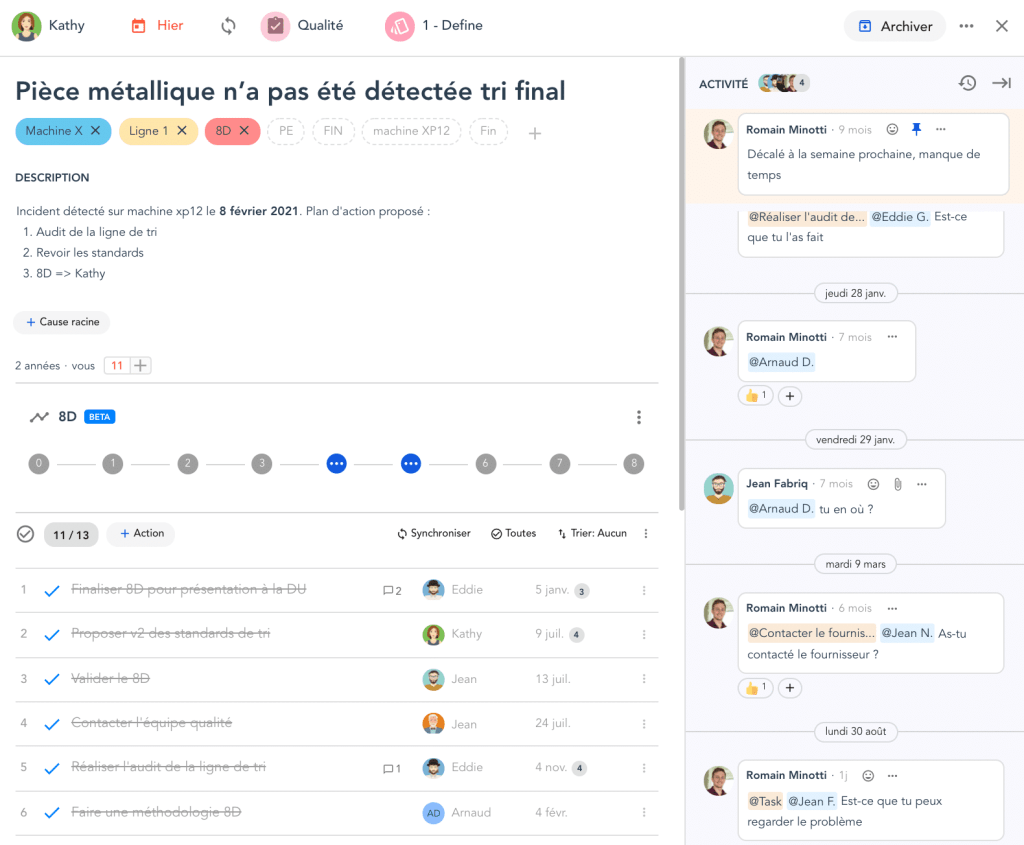
Using a collaborative platform in your teams’ workflows enables you to:
- Provide a single source of information for greater transparency;
- Have real-time information for more effective communication and problem-solving;
- Have consolidated, structured and historic data
It is a real virtuous circle as you are setting off your digital transition while involving your employees in the site’s procedures. Staff members therefore become more motivated and project driven.
Digital collaboration to improve your teams’ overall productivity
According to a McKinsey report, including digital collaboration in workflows can increase productivity by up to 30% in the areas where information circulates most on a daily basis.
Sharing knowledge makes it possible to pass more detailed and personal know-how on to younger generations. In its digital form, training can be used to manage employee turnover on workstations, especially when it comes to an operator who is retiring, and whose job is taken over by a young person.
Data transmission between teams is more reliable and secure. This ensures fast, real-time feedback and improved problem resolution.
Digitalizing processes motivates your teams and therefore makes them more efficient. Communication or field tours that were previously paper-based or on whiteboards now take place on a digital collaboration tool using a touch screen or computer. Information such as a machine reject is raised more quickly, received more quickly and therefore resolved more quickly.
In conclusion, digital collaboration is an integral part of an organization’s transformation as it seeks to improve staff efficiency and productivity, quality of reporting and problem-solving!