

Genchi Genbutsu, often translated as “go and see for yourself,” is a simple yet powerful principle in Lean manufacturing. It’s a mindset that drives leaders and teams to seek truth at the source of the problem. By observing processes directly, manufacturers gain insights that they may not get from a spreadsheet, report, or secondhand account.
This principle is foundational to lean manufacturing principles, and it remains highly relevant today as organizations face complex challenges in quality, efficiency, and workforce engagement. In this blog post we will discuss what Genchi Genbutsu is, why manufacturers struggle without it, and tips to get started with it on your factory floor.
What is the Principle of Genchi Genbutsu?
Genchi Genbutsu is rooted in the Toyota Production System (TPS) and reinforces the idea that real understanding comes from direct observation. Leaders and engineers are encouraged to spend time on the shop floor instead of relying solely on assumptions or data summaries. There they can see how work is actually being done and talk with operators about what they experience.
In practice, this principle often pairs with other Lean tools like Gemba Walks, the 5 Why method, and root cause analysis tools to ensure that improvement decisions are grounded in reality. It’s not about micromanaging or catching mistakes. It’s about building context, identifying problems, and discovering opportunities for kaizen continuous improvement.
The 3 Reals: A Practical Framework for Genchi Genbutsu
In Lean manufacturing, Genchi Genbutsu is often reinforced through what are known as the 3 Reals:
- Go to the real place (Genba)
- Look at the real thing (Genbutsu)
- Understand the real facts (Genjitsu)
Together, these three elements ensure that leaders do more than simply “show up.” They observe the actual process, examine the actual equipment or materials involved, and ground their decisions in real data and firsthand insight.
The 3 Reals transform Genchi Genbutsu from a philosophy into a repeatable management habit that strengthens problem solving and continuous improvement on the shop floor.

Why Manufacturers Struggle Without Genchi Genbutsu
Without Genchi Genbutsu, decision-making tends to happen far from the action. Executives base strategy on filtered reports, dashboards, or updates. While useful, these tools are several steps removed from the realities of the shop floor. Data is critical, but it may not capture the nuances of operator frustrations, machine quirks, or workflow bottlenecks that impact day-to-day performance.
Organizations that skip this principle often face:
- Misaligned solutions: Fixes that don’t address the real root cause.
- Low employee engagement: Operators feel unheard when leaders don’t see their daily reality.
- Slower problem solving: Issues take longer to resolve because decision-makers lack firsthand insight.
In short, without a direct touchpoint with the source, manufacturers risk treating symptoms rather than solving problems. And they lose the opportunity to foster continuous improvement.
Genchi Genbutsu in Practice on the Shop Floor
Let’s go beyond theory and explore how Genchi Genbutsu works on the shop floor. In practice, it’s less about a single event and more about creating habits of presence, observation, and engagement. Here are a few examples of how manufacturers put the principle into action every day:
- Production managers walk the line: Instead of waiting for reports, a manager joins operators at their station, asking open-ended questions about challenges they face and noting small but critical workflow issues.
- Quality engineers dig into root causes: When defects appear, engineers go to the line and observe the process step by step. By pairing Genchi Genbutsu with the 5 Why method, they uncover the real source of the issue rather than relying on surface-level data.
- Leaders practice Lean leadership: Plant leaders who spend time on the floor build credibility and trust. Their presence signals that the shop floor is not only where value is created but also where improvement ideas should be encouraged and acted upon.
- Operators are empowered to share insights: When leaders consistently show up and listen, frontline employees feel more confident raising problems or suggesting kaizen continuous improvement opportunities.
In each case, the act of “going and seeing” makes decision-making more grounded and inclusive. Problems become clearer, solutions become more relevant, and employees feel that their voices are truly part of shaping the future of the operation.
5 Practical Tips to Start Using Genchi Genbutsu
So, how can you put this into practice? Applying Genchi Genbutsu consistently takes discipline and structure. But when done right, it helps build a culture of understanding, trust, and continuous improvement through better problem-solving. If you’re new to the concept, here are some 5 simple steps to put Genchi Genbutsu into practice:
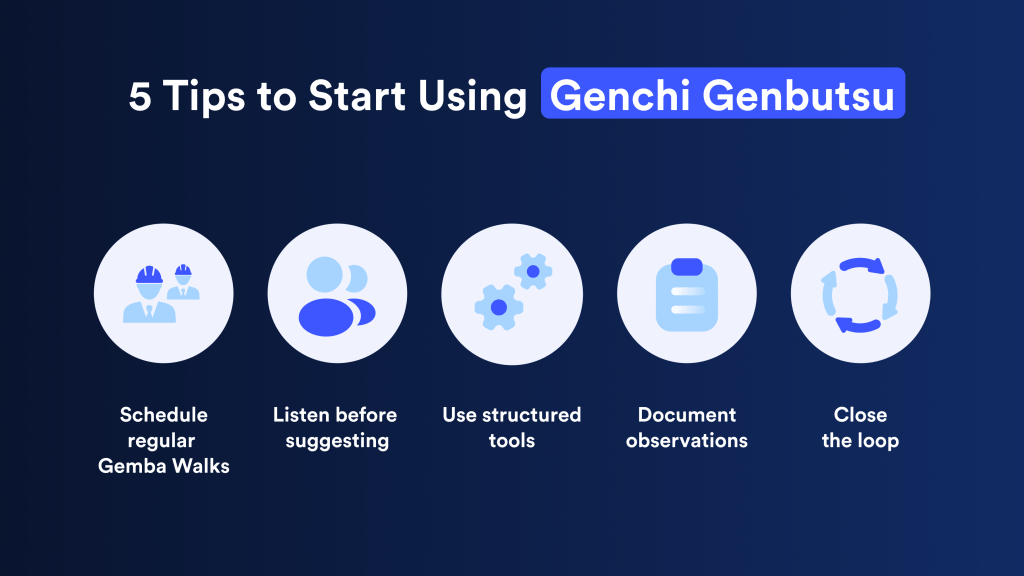
1. Schedule regular gemba walks:
A cornerstone of Genchi Genbutsu is the Gemba Walk. Leaders must leave their offices and spend time on the shop floor observing processes and engaging with employees. Dedicate time each week to go to the shop floor and observe. The key here is regularity. By showing up consistently, leaders demonstrate that the shop floor is where value is created and where the best ideas often originate.
2. Listen before suggesting:
Operators who work with a process every day often have a clearer understanding of what’s wrong than those who only see it occasionally. Ask operators to share their perspective first. Ask open-ended questions and resist the urge to fix immediately. By prioritizing listening, leaders demonstrate respect for frontline expertise.
3. Use structured tools:
Observation is just the first step. It becomes far more effective when paired with structured problem-solving tools. Genchi Genbutsu works best when it fuels lean problem solving and continuous improvement methods.
Apply structured problem solving processes such as root cause analysis, the 5 Whys, value stream mapping (sometimes referred to as stream mapping), or Lean Six Sigma tools to move beyond surface-level issues. These tools keep Genchi Genbutsu from becoming a casual walk-around and instead turn it into a disciplined approach to improvement.
4. Document observations:
It’s important to ensure those insights lead to change. Document observations to ensure that what you learn at the source becomes actionable. Capture what you see with notes and photos and create follow up with actionable steps. This step also helps connect the dots between what leaders observe and the metrics they track, reinforcing the link between shop floor insights and organizational goals.
5. Close the loop:
Now that you have gathered insights, you must share outcomes with the people who provided them. Share what you learned and how it informed your decisions, reinforcing trust with frontline teams. Closing the loop transforms Genchi Genbutsu from an observational exercise into a cycle of continuous improvement that strengthens both processes and relationships.
By starting small and building consistency, manufacturers can make Genchi Genbutsu part of their culture rather than a one-time exercise.
Why Genchi Genbutsu Matters Now
In a time where manufacturers face global competition, supply chain disruption, and labor shortages, Genchi Genbutsu is important. It ensures that leaders stay connected to the realities of production. It empowers manufacturers to make faster, smarter decisions that drive continuous improvement.
At fabriq, we believe principles like Genchi Genbutsu are essential for building resilient, high-performing manufacturing organizations. That’s why we’ve developed resources, like our white paper on Gemba Walks and Lean problem solving, to help manufacturers strengthen their Lean journey.
See how fabriq can help you put Genchi Genbutsu into practice and transform your factory floor.
