

Assembly lines often have sensor-based checkpoints that count the number of components in a piece or weigh different parts. If the sensor detects an anomaly, the production may be stopped automatically. It’s a common example of Poka Yoke in manufacturing systems.
Poka Yoke is a proven method of mistake-proofing lean manufacturing systems to improve efficiency and cut down on defects. This article dives into the need for Poka Yoke and how you can implement it on the shop floor.
What Is Poka Yoke in Why Does It Matter to Manufacturers?
Poka Yoke is a Japanese term that was originally developed in the 1960s as part of the Toyota Production System. The term can be translated to mean ‘mistake proofing’. Poke Yoke process improvement techniques aim to prevent errors in the production process and support quality control. If it cannot prevent the issue, the system is adjusted to identify and fix the mistakes.
Here’s an example.
Let’s say a component must be secured with 6 screws. Manufacturers using Poka Yoke might use a timed release system for screws so workers have 6 screws for every component being handled. There could also be a checking system to ensure the finished product has been fixed with the right number of screws.
This type of error-proofing has many benefits for manufacturers and their workers.

Reduced waste
Poke Yoke methods make it easy for quality control inspectors to quickly identify errors and avoid mistakes. In turn, this cuts down on the amount of rework required to fix defects and manufacturing waste.
Smoother training
Systems using Poka Yoke techniques are designed to make potential mistakes easier to identify and harder to occur. It could be as simple as ensuring a machine cannot work while the door is still open. This lowers the risk of human error and reduces the need for employees to rely on their memory or special training.
Fewer accidents
Implementing mistake-proofing techniques in lean manufacturing systems makes work processes safer with a lower risk of accidents. For example, machines may be set up to start working only after operators are out of the danger zone. Such processes make it harder for employees to accidentally injure themselves and improve the unit’s overall safety standards.
Increased productivity
The combined effect of having to rework fewer pieces, reduced error rates, and established workflow processes increases productivity. Similarly, lowering waste and making production processes more efficient.
Cost-effective production
As manufacturing units reduce their defect rate, they also cut down on expenses related to waste and rework. Similarly, Poka Yoke techniques also cut down on training costs. Further, there’s a lower chance of customers returning defective products – this cuts down on costs associated with customer service, shipping, and returns.
3 Key Types of Poka Yoke Techniques on the Factory Floor
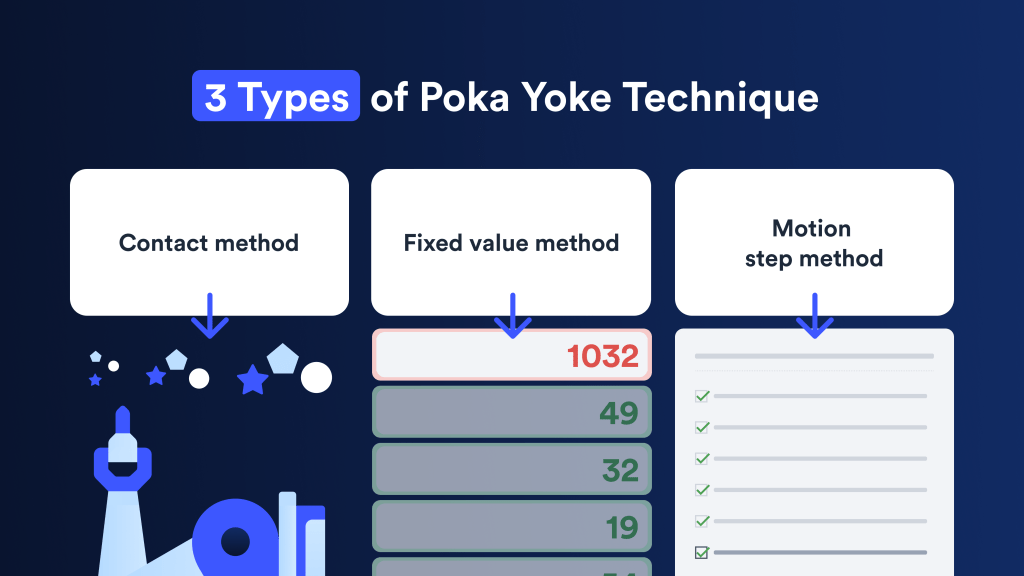
There are many ways to implement Poka Yoke techniques on the shop floor. The approach may be either to prevent human errors or minimize the effects of errors after they have occurred. There are 3 key Poka Yoke techniques that can help achieve this.
Contact method
Contact method Poka Yoke techniques detect errors in the form of defective shapes, colors, sizes, and other physical attributes. It relies on using sensors that alert a worker or machine about the current state of a product.
This method is ideally suited to situations that involve rapid repetition, uncommon production runs, processes with a risk of error caused by poor assembly, and environmental problems such as dust, low light, noise, and so on.
Fixed value method
Fixed value error proofing involves the use of automatic counters and devices that count and control the number of times an activity is performed, length of movement, and other such operating parameters. It may then sound an alert if the specified number of actions are not completed or stop the process from moving forward.
Motion step method
The motion step method refers to implementing a checklist that ensures workers are following all the steps of a manufacturing process. It also ensures that they perform nothing other than the standardized tasks. For example, the company may issue workers digital work instructions with defined tasks and the exact sequence in which they need to be completed.
This method is typically used when a single operator needs to complete a series of different activities.
Why is Poka Yoke Key for Sustainable Lean Manufacturing
Implementing Poka Yoke systems is an easy way for manufacturers to manage and sustain lean manufacturing. Solutions need not always be expensive. Instead, they often integrate simple, inexpensive, easy-to-implement activities that can be integrated with existing processes.
Implementing these solutions reduces manufacturing mistakes and the factory’s overall defect rate. This results in better quality products and builds confidence amongst workers and stakeholders as well as customers. It also signals the company’s commitment to continuous improvement.
Tips to Implement Poka Yoke in Your Operations
There’s no one path to implementing Poka Yoke in a manufacturing setting. That said, there is a general overall structure that may be helpful.
- Step 1: Identify the problem
Take a closer look at the product as well as the assembly and manufacturing process to identify the issue and the nature of the problem. For example, is the problem caused by human error or a flaw in the assembly process?
- Step 2: Understand the root cause
There are a number of root cause analysis tools you can use to identify why a problem is occurring. For example, you may use the ‘5 Whys’ technique, Gemba walks, or the Ishikawa diagram.
- Step 3: Determine the ideal Poka Yoke technique
Poka Yoke solutions could be designed to stop the manufacturing process when a problem is identified or sound an alert to attract human intervention. This could be in the form of buzzers, the Andon light system, error code messages, etc.
In other cases, the manufacturing process or the product itself may be redesigned to avoid errors. Simple, low-cost changes like colour coding can be very effective.
- Step 4: Test and validate
Test the chosen Poka Yoke solution on a small-scale pilot project in a controlled environment. You can introduce the changes to a specific machine or an assembly line. This will help you monitor the effect and adjust the mechanisms for better results.
- Step 5: Update SOPs and deploy
Once the pilot project has been successfully completed, the Poka Yoke system can be implemented across the shop floor. This would involve updating the standardized work instructions issued to employees and training them on the new system. Using digital visual management boards like Fabriq makes it easier to ensure that everyone refers to the most updated SOPs and minimizes the risk of ambiguity.
The Smart Route to Integrating Poka Yoke
Having the right tools to implement Poka Yoke techniques goes a long way toward error-proofing lean manufacturing systems and improving quality control. Digital visual management tools like fabriq can play a pivotal role in collecting real-time information to understand the root cause of problems, encouraging collaboration to design solutions, distributing updated SOPs, and more. It also helps managers monitor and review the processes to identify other opportunities for improvement.
Discover how fabriq can help you error-proof your shop floor using real-time visual management tools.
