

Definition of the Daily Management System or DMS
A Daily Management System, or DMS, is a way of enabling the best possible management of an organization’s processes. In other words, it’s the whole range of good practices (routines and other day-to-day operations) that ensure the results measured in the field are in line with the production site’s operational objectives.
A DMS is not the same as an MES, which is a factory production control and monitoring tool. An MES collects production data in real time and provides total traceability of the manufacturing process.
All these operational tracking measures apply at all levels of the company: from the position closest to value creation, right up to the highest levels of the organization, such as executives and senior management.
How is DMS organized?
In general, managers make regular site visits to ensure they have requirements, productivity, quality of operations and performance indicators under control. Audits are carried out to ensure compliance with established standards and continuous process improvement.
Afterwards, a communication structure is put in place to ensure effective information is shared at the different levels of the organization, and to enable collaboration to resolve any problems.
All DMS-related activities can therefore be grouped into three categories:
- knowledge management
- process inspection
- operational monitoring, communication and problem-solving.
6 Core Components of a Daily Management System
A successful Daily Management System (DMS) relies on a set of interconnected practices that help organizations monitor performance, solve problems, and drive continuous improvement every day. While the exact structure may vary from one organization to another, most effective daily management systems include the following core components.
1. Daily Tier Meetings
Daily tier meetings are short, structured meetings held at different levels of the organization to review performance, discuss issues, and align priorities. These meetings create a communication cascade that ensures important information flows quickly from frontline teams to leadership and back again.
By reviewing key metrics, operational challenges, and action plans every day, teams can respond to problems faster and maintain alignment with operational goals.
2. Visual Performance Management
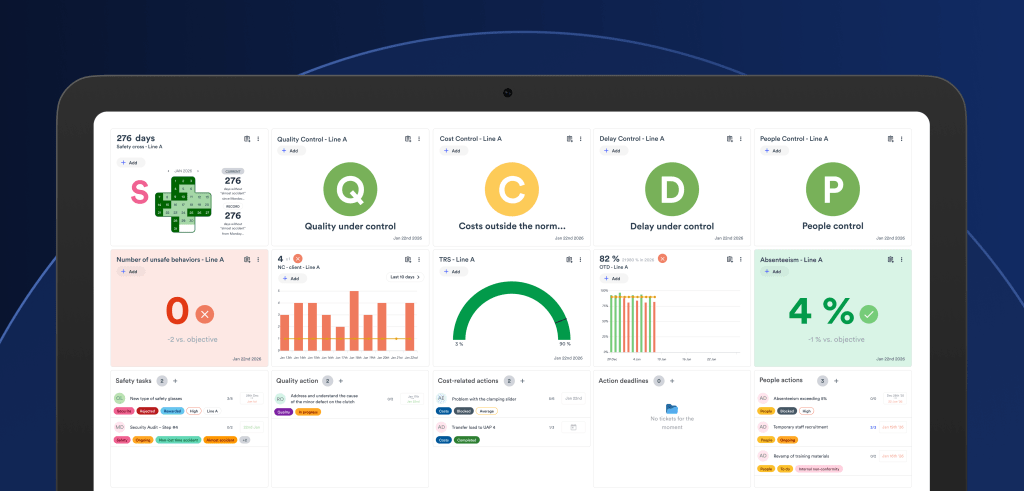
Visual management makes performance visible and actionable. Teams use dashboards, KPI boards, and digital displays to track critical metrics related to Safety, Quality, Delivery, Cost, and People (SQDCP).
By making performance indicators accessible to everyone, visual management helps teams quickly identify deviations, understand priorities, and take corrective action before issues escalate.
3. Leader Standard Work
Leader Standard Work consists of structured routines that help managers consistently support operational performance. These routines may include reviewing KPIs, conducting Gemba walks, coaching employees, and participating in daily meetings.
By standardizing management activities, organizations ensure that leaders spend time on the actions that have the greatest impact on safety, quality, productivity, and continuous improvement.
4. Gemba Walks and Shop Floor Audits
Gemba walks and audits help leaders stay connected to operations by observing work where value is created. These activities allow managers to verify standards, identify risks, and better understand the challenges faced by frontline teams.
Regular shop floor observations encourage proactive problem-solving and create opportunities to engage employees in improvement efforts.
5. Problem-Solving and Escalation
Not every issue can be solved at the frontline level. A Daily Management System establishes clear escalation processes so that unresolved problems are addressed by the appropriate level of management without delay.
Combined with structured problem-solving methods such as root cause analysis and the 5 Whys, escalation processes help organizations resolve issues quickly while preventing recurring problems.
6. Continuous Improvement
Continuous improvement is the foundation of any effective Daily Management System. Teams use problem-solving techniques, corrective actions, and Kaizen activities to eliminate waste, improve processes, and strengthen operational performance over time.
By embedding continuous improvement into daily routines, organizations create a culture where every employee contributes to operational excellence and long-term success.
What are the benefits of the Daily Management System?
The main benefits of the DMS is that it guarantees rapid and effective response to performance shortfalls at all levels of problem-solving. It has 4 pillars:
- Visual management, which enables staff to clearly see whether performance is good or bad on a given day and to suggest corrective measures at the appropriate time
- Shop floor tours, or Gemba Walk routines, which are used to observe compliance with defined safety or quality standards in the field, or any other standard defined by the company
- The action plan, through which to monitor the actions carried out and objectives achieved, on a daily basis.
- Escalation, so that information is dealt with by the person who is best able to make rapid decisions to get back to the expected performance level.
Why digitalize your Daily Management System?
Digitalizing your DMS is a must in terms of saving time, solving problems faster and ensuring your production staff are invested. Here’s why you should digitalize your daily management system:
Have a single source of information
This source of information is visible on all production sites, and data is updated in real time, and can even be supplemented by diagrams, photos or videos. This provides greater oversight on performance.
Save considerable time and solve problems twice as fast
Meeting preparation is faster for team leaders because they have all the necessary information at their fingertips thanks to dashboards or reports. For the production staff, problems are also solved more quickly thanks to faster communication and being able to speak directly to the right person. This cuts out ‘the middle man’.
Connect production teams and improve their investment
Production staff are more self-reliant, and have a tool for reporting any problems. This boosts everyone’s ownership and investment. All of this means risks are monitored more effectively, and fosters a collaborative working environment, in which everyone can work more freely. Problem reporting is more accurate, as each user will be able to describe them directly in the tool.
A rich database at hand
Creating a history of problems and solutions will help you to become more efficient over time. The problem history provides a back-up of problems that have previously been encountered and how they were resolved. Staff have access to a wealth of knowledge through the stored problem history. And that knowledge will certainly help avoid recurrences.
Implementing a DMS fosters a culture of continuous improvement. Every problem solved in the field benefits the whole organization and reduces the recurrence of operational problems.
How to Implement a Daily Management System in 6 Steps
Implementing a Daily Management System requires more than introducing new meetings or dashboards. To be effective, a DMS must align people, processes, and performance around a common set of operational goals. The following six steps can help organizations successfully deploy a lean daily management system.
1. Define Your Operational Objectives
Start by identifying the business objectives your Daily Management System will support. These objectives may include improving safety performance, reducing downtime, increasing quality, improving on-time delivery, or boosting employee engagement.
Clear objectives provide direction for the entire system and ensure daily activities contribute to broader organizational goals.
2. Select Your Daily KPIs
Choose a small number of key performance indicators that teams can influence and review on a daily basis. Many organizations use metrics aligned with the SQDCP framework, covering Safety, Quality, Delivery, Cost, and People.
Avoid tracking too many metrics. Focusing on a limited set of meaningful KPIs helps teams stay engaged and act quickly when performance deviates from target.
3. Establish Daily Management Routines
Create standard routines that support operational control and communication. These may include daily tier meetings, shift handovers, Gemba walks, audits, and KPI reviews.
Clearly define who participates, how often activities occur, and what information should be reviewed. Consistent routines create accountability and help teams identify issues early.
4. Create Escalation Processes
Some problems can be solved immediately by frontline teams, while others require support from supervisors or leadership. Establish clear escalation rules so employees know when and how to raise issues.
A structured escalation process reduces delays, accelerates decision-making, and ensures critical issues receive the attention they need.
5. Standardize Problem-Solving Methods
To prevent recurring issues, organizations should adopt a consistent approach to problem-solving. Methods such as the 5 Whys, PDCA cycle, A3 problem-solving, and root cause analysis help teams move beyond symptoms and address underlying causes.
Standardizing problem-solving practices also improves collaboration and creates a shared language for continuous improvement across the organization.
6. Digitalize Your DMS for Visibility and Collaboration
Many organizations still manage daily operations using whiteboards, spreadsheets, and paper-based processes. While these tools can work initially, they often limit visibility and slow down communication.
Digitalizing your Daily Management System centralizes information, provides real-time performance visibility, and enables faster collaboration across teams and sites. With digital dashboards, action plans, audits, and problem-solving tools in one place, organizations can improve responsiveness, strengthen accountability, and accelerate continuous improvement.
7 Practical Tips to Make Your Daily Management System Work on the Shop Floor
1. Standardize your daily rituals before tracking performance
A DMS only works if routines are consistent. Define when the team holds daily meetings, who attends, which KPIs the team reviews, and how the team escalates issues. Standardized work for managers addresses problems the same way every day, regardless of the shift or team.
2. Focus on a small set of KPIs that teams can influence daily
Avoid overloading boards with metrics. Track a limited number of indicators related to safety, quality, delivery, and downtime. The goal of a lean daily management system is improving daily performance, not reporting everything that happened yesterday.
3. Make problems visible in real time
If issues are discussed hours or days later, the DMS loses impact. Use visual management to surface deviations as soon as they occur. Real-time visibility helps teams react quickly and prevents small problems from turning into recurring ones.
4. Link every problem to a clear action and owner
Identifying a problem is only useful if it leads to action. Every problem in daily management should result in a clear action. Assign a person responsible and set a clear deadline. This keeps the DMS focused on execution, not discussion.
5. Use escalation rules to support fast decision-making
Not every issue can be solved at the shop-floor level. Define clear escalation thresholds so problems are addressed by the right level of management without delay. This keeps daily management aligned with strategic goals while avoiding bottlenecks.
6. Integrate problem-solving into daily routines
Daily management is not just about tracking performance; it’s about learning. Encourage teams to use simple root cause analysis tools during daily meetings to understand why issues occur and how to prevent them from happening again.
7. Review and improve your DMS regularly
A DMS should evolve as your organization matures. Regularly review meeting formats, KPIs, and escalation processes to ensure they still support operational priorities. Continuous improvement applies to the management system itself, not just production processes.
Turn Your Daily Management System Into a Driver of Continuous Improvement
Now that you understand the importance of a DMS, it’s time to find out how to centralize and effectively tap into all this information to optimize your operations. At fabriq, we’ve designed a digital dashboard that lets you gather all the information to do with your shop floor rituals and routines. You’ll have access to features such as checklists, audits and field tours, action plans, performance indicators, as well as problem-solving tools.
Find out more about the fabriq digital dashboard to simplify your DMS management and bolster your continuous improvement culture.

Daily Management System (DMS) FAQs
What is a Daily Management System (DMS)?What is a Daily Management System (DMS)?
A Daily Management System (DMS) is a set of routines and day-to-day management practices that help ensure shop-floor results align with a production site’s operational objectives.
Is a Daily Management System the same as an MES?
No. A DMS focuses on daily management routines, communication, and problem-solving, while an MES is a production control and monitoring system that collects manufacturing data in real time and provides traceability.
How is a Daily Management System organized?
A DMS is organized around regular shop-floor visits, audits, and structured communication. Activities typically fall into knowledge management, process inspection, and operational monitoring, communication, and problem-solving.
What are the main benefits of a Daily Management System?
A DMS enables fast and effective responses to performance gaps through visual management, Gemba Walks, action plans, and escalation. This helps teams address problems quickly and improve operational performance daily.
Why should manufacturers digitalize their Daily Management System?
Digitalizing a DMS provides a single source of real-time information, speeds up problem-solving, improves team engagement, and creates a searchable history of problems and solutions to avoid recurrence.