

Lean manufacturing was pioneered by Toyota and has since been adopted by many more manufacturing units across industries. For Caterpillar, adopting lean manufacturing tools helped increase revenue by 31%. Similarly, Intel was able to cut down on idle time by 60% with the help of lean manufacturing tools.
If you’re thinking of using lean principles on your factory floor, here are the top 15 lean manufacturing tools that could help you.
What is Lean Manufacturing?
Lean manufacturing is a methodology focused on maximizing productivity while minimizing waste. This is aimed at delivering more value to customers with fewer resources. Communication, teamwork, quality control and maintaining a culture of continuous improvement are key to achieving this.
The Best Lean Manufacturing Tools
Here are the top 15 lean manufacturing tools and the principles behind them.
1. Digital Visual Management Tools
Digital Visual Management Tools are lean manufacturing solutions that improve internal communication and management of the shop floor. Solutions, like Fabriq for example, help you identify issues, solve problems quickly, and drive continuous improvement. They generate real-time digital dashboards, charts, graphs, and KPIs that are easy to understand. They help workers quickly grasp what needs to be done, when and how. By keeping all teams on the same page, Digital Visual Management Tools improve efficiency, reduce wasted time, and help create a safer workplace.
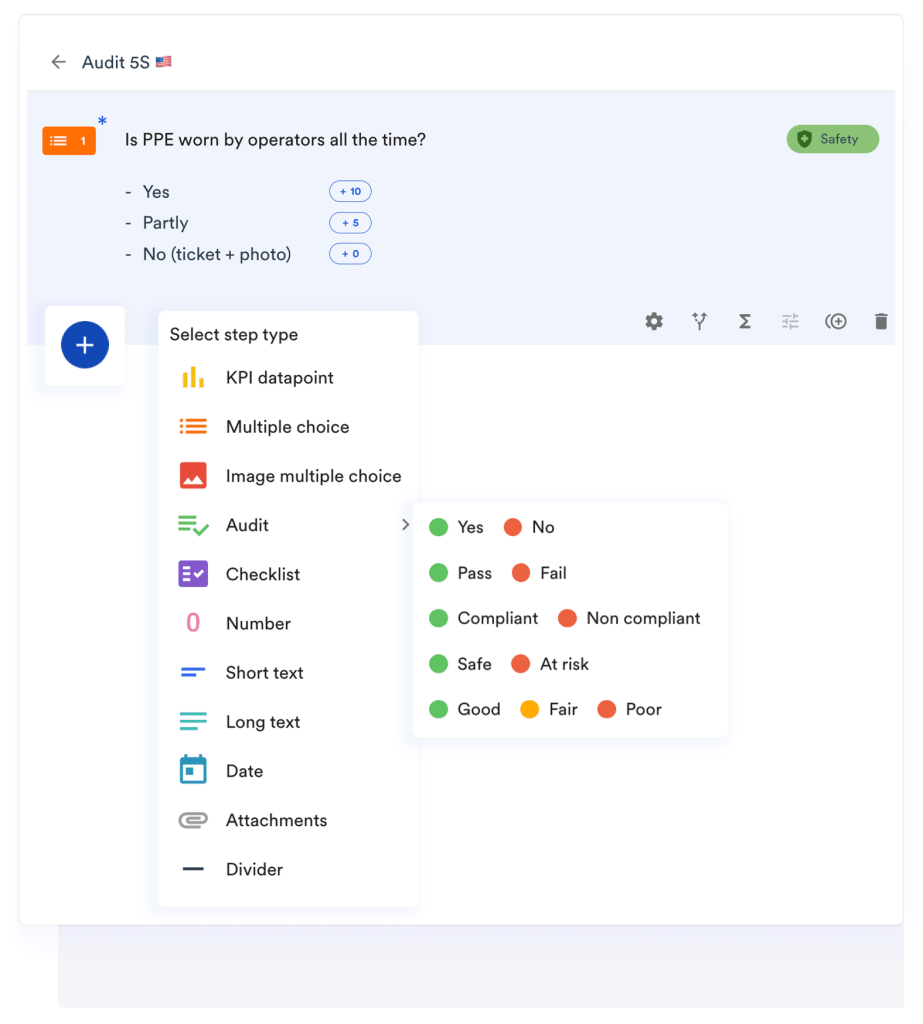
2. 5S audit
5S audits are systematic evaluations of how a manufacturing unit complies with the 5S methodology, which stands for Sort, Straighten, Shine, Standardize and Sustain. A 5S audit could look like:
- Sort: Distinguish between necessary and unnecessary materials
- Straighten: Organize necessary materials to be easy to find and use
- Shine: Clean the workplace
- Standardize: Design standards to maintain the effects of the earlier steps
- Sustain: Encourage habits to guarantee the process is followed
Ultimately, it increases efficiency and enables continuous improvement.
3. 5 whys or 5W
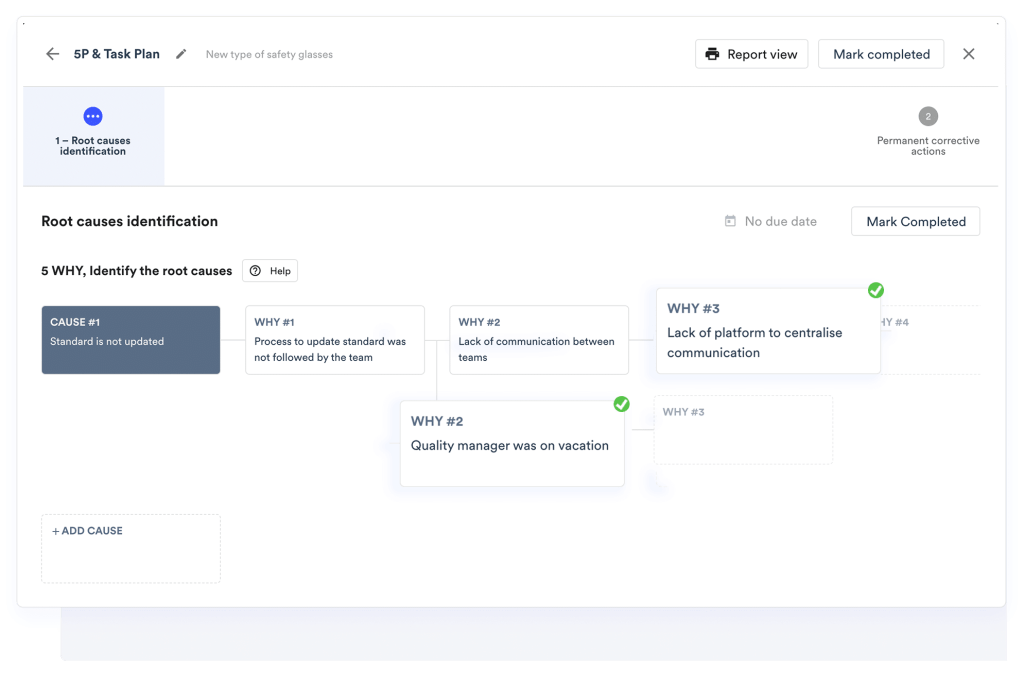
This is a process that can help understand the root cause of a problem without jumping to conclusions. As the name suggests, it involves asking Why in answer to the previous question 5 times. Here’s an example of 5 whys:
Problem: A customer’s order will take too long to be delivered.
- Why: a machine stopped working
- Why: a worker tried to fix a small issue but worsened the problem
- Why: the machine has not been maintained
- Why: the maintenance contract has not been renewed
- Why: the company is still negotiating with service providers
This gives you a deeper understanding of all the layers to a problem to create a holistic solution.
4. Andon light system
The Andon light system is one of the most popular lean manufacturing tools to flag operational issues. The system involves using different-colored lights to signal issues on the production line. For example, a machine may have a green light when it is operating normally, a yellow light for minor issues, and a red light for major production problems.
5. Gemba walks
Gemba walks are lean manufacturing tools focused on increasing engagement. Based on the idea that not all problems can be solved remotely, Gemba walks direct engineers to be physically present on the manufacturing floor. During their walks, they can observe processes, collect data, learn about problems and ideate solutions.
6. Hoshin Kanri
This is a lean manufacturing tool for long-term planning. Hoshin Kanri can be described as a seven-step planning process to determine overall objectives and create action plans aligned towards them. The 7 steps are:
- Create an organizational vision
- Establish strategic objectives for the next 3-5 years
- Establish annual objectives
- Determine measurement metrics
- Implement steps to meet objectives
- Monthly reviews
- Annual reviews
Ultimately, it allows you to align your goals and improve your focus and execution.
7. Jidoka
The principle of Jidoka can be broken down into 4 steps:
- Automatic problem detection
- Automatic stoppage and alert notification
- Human intervention to fix the current problem
- Analysis to discover and address the root cause
For example, a printer can automatically detect the wrong-sized paper and pause the printing process. The machine sends an alert and employees can then change the paper. Steps can then be implemented to keep the error from being repeated.
8. Just-in-time
Just-in-Time is a lean manufacturing model that drives production according to actual demand. It reduces the need to hold extra inventory and thus makes your operations more cost-effective. On the factory floor, you can also use it to deliver parts and raw materials only at the stage they are required rather than all at once, optimizing usage time.
9. Kaizen
Kaizen focuses on bringing about continuous improvement by getting everyone to make small, incremental changes. It is often paired with other lean manufacturing tools such as the 5S audit and PDCA.
It usually involves 5 steps:
- Identify a problem area
- Analyze the current process
- Ideate and test improvements
- Implement the new process
- Analyze results and standardize the solution
Kaizen also encourages all employees to actively participate in problem-solving, increasing employee involvement and engagement.
10. Kanban
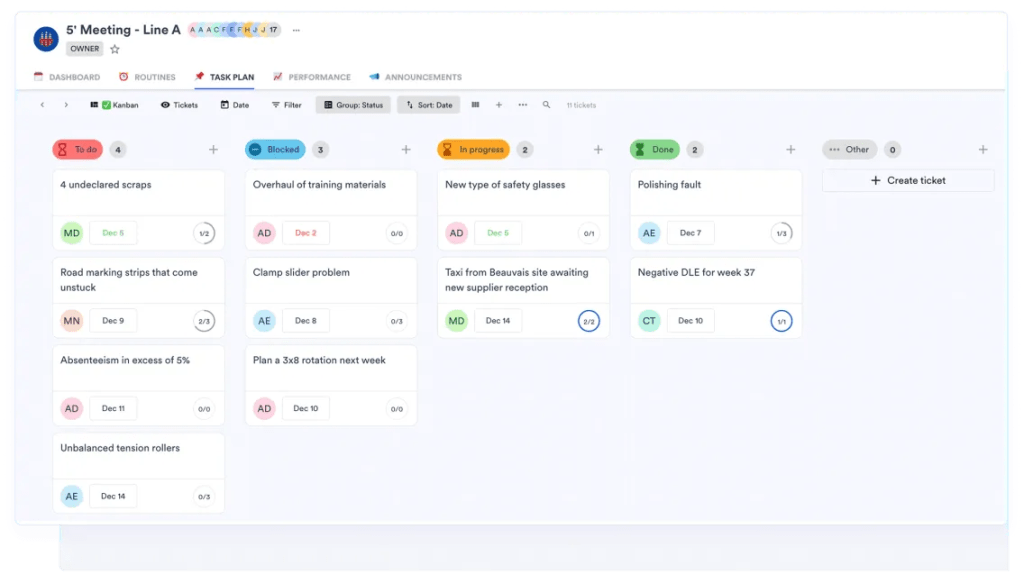
Kanban is a lean manufacturing tool aimed at reducing waste by balancing demand and inventory. In today’s tech-driven world, you can use digital Kanban boards to track the flow of a task through columns such as “Issued”, “In Progress” and “Done”. As tasks move through the columns and cross a pre-set threshold, you can automatically request additional raw material, parts, etc.
For example, a shirt manufacturer may use the Kanban system to reorder fabric after every 50 shirt orders move from the cut to stitch phase.
11. PDCA
PDCA stands for Plan Do Check Act. This is a 4-step lean manufacturing tool used to create and implement change. It involves:
- Plan: Plan changes to improve an existing process
- Do: Conduct a pilot program to test the change
- Check: Analyze results
- Act: Implement the change or restart the process if the test results were not satisfactory.
12. Poka Yoke
Poka Yoke is similar to Jidoka and focuses on ‘mistake-proofing’ manufacturing processes. This involves the use of sensors to identify errors and potential defects. It is especially beneficial for processes that rely on worker skill and attention to detail.
For example: A conveyor belt carrying the finished product to the packaging drop-off flags products that have a lower-than-expected weight.
13. One Piece Flow
This lean manufacturing tool involves focusing on a single product as it moves from one stage of manufacturing to another. The team involved in stage 1 of production can move on to making the second piece only when the stage 2 team has accepted the quality of the first piece. Doing so makes it easier to detect quality issues and provides flexibility for customization. It also reduces inventory and shortens the lead time to delivery.
14. SMED method
SMED stands for Single-Minute Exchange of Die. This is aimed at cutting down set up and equipment changeover time. The idea here is to identify tasks, wherever possible, convert internal steps to external steps and determine low-cost solutions to get them done faster. For example, standardizing nut configurations can reduce the time taken to install tires on a car.
15. Value stream mapping
Value stream mapping is a lean manufacturing tool that depicts the different steps of a process in the form of a flow diagram. This helps you identify steps that are not adding value. In turn, these steps can be changed or removed to make your process faster and more efficient.
For example, it can identify an overly complex process that could be simplified or find instances where production targets can be reduced.
Leveraging lean manufacturing tools to optimize production
From consumables to automobiles, lean manufacturing tools like Fabriq can optimize production across all industries. Fabriq facilitates horizontal and vertical communication and provides real-time visibility into operations, quickening troubleshooting scenarios and supporting continuous improvement. The user-friendly interface further makes it easy for all teams to track progress and manage day-to-day tasks. The benefits add up quickly, allowing you to increase profit margins and deliver exceptional products.
