

Manufacturers face increasing pressure to produce more with less. From rising material costs to supply chain disruptions and the demand for sustainable practices, efficiency is a necessity. One proven method that continues to gain traction among plant managers and lean leaders is JIT production, or Just-in-Time manufacturing.
Originating from Japan’s renowned Toyota Production System, JIT has become a cornerstone of lean thinking, helping factories streamline operations, reduce waste, and improve responsiveness. But as digitalization reshapes manufacturing, understanding how to adapt and implement JIT principles is more relevant than ever.
This article explores the fundamentals of JIT production, its role in lean manufacturing, and how modern tools and practices can help manufacturers fully realize its benefits in a connected, digital-first environment.
What Is JIT Production, or Just-in-Time Production?
Just-in-Time (JIT) production is a manufacturing strategy that aligns raw material orders and production schedules directly with customer demand. Rather than producing large quantities and storing excess inventory, JIT focuses on producing only what is needed, when it’s needed, and in the quantity needed.
This “pull” system contrasts with traditional “push” systems that produce based on forecasts. By lowering inventory levels and speeding up order fulfillment, JIT helps manufacturers work more efficiently and control costs.
Key characteristics of JIT production:
- Reduced inventory of raw materials and finished goods
- Smaller batch sizes and frequent changeovers
- Close coordination with suppliers for timely deliveries
- Focus on quality at the source to minimize defects
- Standardized work and continuous flow
Originally implemented by Toyota in the mid-20th century, JIT has since become an industrial best practice. It supports the broader goal of operational excellence by aligning resources with real-time demand and removing inefficiencies.
Core Principles of a JIT Production System
A successful JIT production system is built on a set of operational principles. These principles work together to eliminate waste, improve flow, and align output with real customer demand. The principles below create the structure needed to sustain Just-in-Time performance over the long term.
Pull System
At the heart of JIT production is the pull system. Instead of producing goods based on forecasts (a push system), production is triggered by actual customer demand.
In a pull-based JIT production system:
- Each process produces only what the next process needs
- Materials are replenished only when consumed
- Inventory levels remain minimal
- Overproduction, a damaging form of waste, is eliminated
Kanban systems are commonly used to manage pull production. Kanban signals tell teams when to replenish materials so production stays synchronized across the value stream.
By aligning output directly with demand, the pull system reduces excess inventory, shortens lead times, and improves responsiveness.
One-Piece Flow
One-piece flow means products move through the production process one unit at a time instead of in large batches.
In traditional batch production, items sit in queues between workstations, creating waiting time and excess work-in-progress (WIP). In contrast, JIT production promotes continuous flow, where each unit moves immediately to the next step without delay.
Benefits of one-piece flow include:
- Faster problem detection
- Reduced WIP inventory
- Shorter production lead times
- Improved product quality
- Greater production flexibility
One-piece flow strengthens JIT production by keeping materials moving smoothly and exposing inefficiencies quickly.
Setup Time Reduction (SMED)
Small batch production is a key characteristic of JIT production. However, frequent changeovers can create downtime unless setup times are minimized.
This is where SMED (Single-Minute Exchange of Die) comes in. SMED focuses on reducing equipment changeover time to less than 10 minutes wherever possible.
Reducing setup times enables:
- Smaller batch sizes
- Increased flexibility
- Faster response to demand changes
- Lower inventory requirements
By making changeovers faster and more predictable, SMED supports the agility required for effective JIT production.
Jidoka and Andon
Jidoka, often translated as “automation with a human touch,” is a principle that ensures quality is built into the process rather than inspected at the end.
In a JIT production system:
- Machines automatically stop when abnormalities occur
- Operators are empowered to halt production if defects are detected
- Problems are addressed immediately at their source
Andon systems signal when issues arise on the shop floor. These alerts trigger rapid response and escalation, preventing defects from moving downstream.
By combining Jidoka and Andon, JIT production protects product quality while maintaining continuous flow.
Total Productive Maintenance (TPM)
Because JIT production operates with minimal inventory buffers, equipment reliability is critical. Unexpected breakdowns can quickly disrupt the entire value stream.
Total Productive Maintenance (TPM) focuses on:
- Preventative maintenance
- Operator-led equipment care
- Continuous monitoring of machine performance
- Reducing unplanned downtime
TPM ensures that machinery is available when needed and performing at optimal efficiency. In a JIT production system, this stability is essential to maintaining flow and meeting customer demand without delays.
Together, these principles form the operational backbone of JIT production. When implemented collectively, they create a lean, responsive, and resilient production system aligned with real-time demand.
How JIT Production Supports Lean Manufacturing
JIT production is not a standalone technique. It is a fundamental part of lean manufacturing. Lean is a holistic approach to production that seeks to maximize customer value while minimizing waste. The goal of lean is to create more value with fewer resources, and JIT plays a critical role in that mission.
JIT is a lean building block. Lean manufacturing identifies eight types of waste (or “muda”) that hinder efficiency: overproduction, waiting, transport, extra processing, inventory, motion, defects, and underutilized talent. JIT directly targets overproduction and excess inventory, often seen as the most damaging wastes.
JIT also supports other lean methodologies such as:
- Takt time: aligning production pace with customer demand
- Kanban: visual systems for managing flow and signaling replenishment
- Heijunka: production leveling to smooth out workload fluctuations
- Gemba walks: observing work on the shop floor to spot inefficiencies
When executed properly, JIT becomes a lever for improving flow, responsiveness, and quality while enabling a more flexible workforce.
Benefits: How JIT Production Improves Efficiency
Implementing JIT production can yield substantial benefits across manufacturing operations. Below are the most impactful ways JIT boosts efficiency, reduces waste, and enhances performance:
1. Lower Inventory Costs
With JIT, factories carry only the materials needed for current production. This leads to less capital tied up in raw materials and reduced warehouse space and handling costs. Furthermore, it lowers the risk of obsolescence or spoilage.
2. Improved Production Flow
JIT encourages a smooth, continuous flow of materials and products through the value stream. By producing in small batches and minimizing downtime, manufacturers can shorten lead times, eliminate bottlenecks and increase agility.
3. Enhanced Product Quality
Smaller lot sizes make it easier to detect and correct defects early, reducing rework and scrap. When used with error-proofing (poka-yoke) and root cause analysis tools like the 5 Whys method, JIT improves quality standards.
4. Greater Employee Engagement
JIT creates an environment where frontline teams are empowered to solve problems and take ownership of performance. Tools like digital performance boards and real-time escalation workflows allow operators to surface issues quickly and drive accountability.
5. Stronger Supplier Relationships
Close collaboration with suppliers becomes essential in a JIT system. This fosters long-term partnerships built on trust, transparency, and shared goals for efficiency and responsiveness.
6. Reduced Waste Across the Board
Finally, JIT matches production with demand. By synchronizing production with real customer demand, JIT eliminates overproduction. It also leads to less motion and overprocessing as well as lower energy and resource consumption. This demand-driven approach ensures that every activity adds measurable value to the customer.
5 Tips to Implement JIT Production in Your Factory
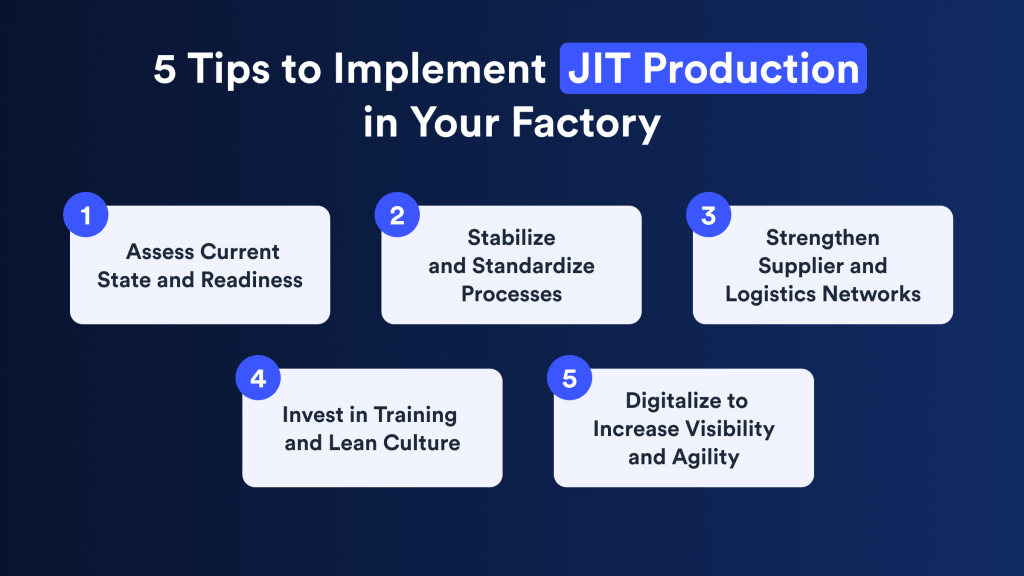
Transitioning to JIT production requires careful planning and cross-functional coordination. Here are key steps and best practices to guide your journey:
1. Assess Current State and Readiness
Map your existing value streams to identify inventory levels, lead times, and waste. Use digital tools to track production performance and bottlenecks. Engage teams early and explain the benefits of JIT to gain buy-in.
2. Stabilize and Standardize Processes
Establish standard work procedures to ensure consistency. Level production with Heijunka where applicable. Apply takt time calculations to set rhythm and expectations.
3. Strengthen Supplier and Logistics Networks
Evaluate supplier reliability and responsiveness. Introduce Kanban systems for parts replenishment. Build contingency plans for supply chain disruptions.
4. Invest in Training and Lean Culture
Empower frontline workers to identify and solve problems. Encourage daily Gemba Walks to reinforce accountability. Recognize improvements and celebrate milestones.
5. Digitalize to Increase Visibility and Agility
Implement a daily management system (DMS) software like fabriq to connect frontline teams, track metrics, and escalate issues. Use real-time dashboards to monitor cycle times, production rates, and issue resolution. Connect your JIT system to broader digital transformation initiatives.
Digital Transformation: the Future of Just-in-Time
JIT production was once viewed as a purely operational practice. Now it is a strategic lever in the era of smart manufacturing. As manufacturers embrace digital transformation, the future of JIT lies in connected systems, real-time data, and predictive insights.
Digitalization takes Just-in-Time (JIT) practices to the next level. With IoT sensors, manufacturers can monitor inventory in real time and even trigger automated replenishment before stock runs out. And when slowdowns or quality issues pop up, digital escalation ensures rapid response so production keeps moving.
Pair that with performance management tools that bring everyone together around the same metrics and visual dashboards, and you get a smarter, faster, and more resilient JIT system that drives real operational excellence.
JIT production offers manufacturers a proven framework for operational excellence. Platforms like fabriq help manufacturers move beyond old JIT systems. Digitalizing workflows and improving communication between shifts empowers leaders to drive continuous improvement on a large scale.
Learn how fabriq can support your JIT journey.

JIT (Just-in-Time) production FAQs
What is JIT production?
JIT production, or Just-in-Time production, is a strategy where goods are produced only when needed, in the exact quantity required, based on actual customer demand. Instead of relying on forecasts and building excess inventory, JIT production uses a pull system to reduce waste, lower inventory costs, and improve production flow.
What are the key principles of JIT production?
The core principles of JIT production include:
- Pull production based on demand
- Continuous or one-piece flow
- Small batch sizes
- Setup time reduction (SMED)
- Built-in quality (Jidoka)
- Equipment reliability (TPM)
These principles work together to eliminate waste and improve efficiency.
How does JIT production reduce inventory costs?
JIT production reduces inventory costs by aligning raw material orders and production schedules directly with customer demand. By producing only what is needed when it is needed, manufacturers minimize excess stock, reduce storage and handling costs, and lower the risk of obsolescence.
What is a pull system in JIT production?
A pull system in JIT production means that each stage of the production process is triggered by actual demand from the next stage or from the customer. Instead of producing based on forecasts, materials and products move through the system only when needed, preventing overproduction and excess inventory.
What are the benefits of JIT production?
JIT production offers several benefits:
- Reduced inventory and storage costs
- Shorter lead times
- Improved product quality
- Increased production flexibility
- Better supplier collaboration
- Reduced waste across operations
How is JIT production related to lean manufacturing?
JIT production is a core component of lean manufacturing. While lean manufacturing is a broader philosophy focused on maximizing customer value and eliminating waste, JIT production specifically focuses on producing goods in response to real demand to reduce inventory and improve flow.
How can digital tools improve JIT production?
Digital tools enhance JIT production by:
- Providing real-time inventory and production data
- Enabling faster issue detection and escalation
- Improving communication across teams and shifts
- Supporting performance tracking and continuous improvement
This makes JIT systems more resilient and scalable.
How do you implement JIT production successfully?
To implement JIT successfully:
- Assess current processes and identify waste
- Standardize and stabilize operations
- Build strong supplier relationships
- Train teams in lean principles
- Use digital tools for visibility and coordination