

Somewhere around the mid-20th century, the manufacturing world changed in a profound way. The Toyota Production System (TPS) developed back then compelled companies to think of quality, efficiency, and operational excellence in a whole new light. And at present, it is the cornerstone of lean manufacturing practices that various industries use around the globe.
TPS, at its heart, is about removing waste, enhancing production flow, and enabling employees to solve issues. It isn’t about attaining maximum output at any cost. Rather, the Toyota Production System banks on employing minimal resources to deliver value to customers. Over the years, this line of thinking has allowed manufacturers to reduce costs, improve production efficiency, and improve product quality.
With the manufacturing landscape becoming more complicated than ever – thanks to increasing customer expectations, global supply chains, and significant technological shifts – TPS principles continue to be extremely relevant.
This write-up helps you understand all about it, so you can build manufacturing processes that are adaptable, resilient, and efficient.
What Is the Toyota Production System?
A comprehensive manufacturing philosophy as well as operational framework, TPS helps optimize production by getting rid of waste and boosting efficiency.
Unlike conventional systems of production that prioritize output volume, TPS revolves around value delivery through high-quality, flexible and efficient processes. It creates a cohesive and constantly improving system by integrating processes, people, and technology.
Hence, the core ideas behind TPS are:
- Producing only what’s required and when it is required
- Identifying waste in all its forms and eliminating the same
- Empowering workers to spot and address problems
- Creating a consistent and smooth flow of production
Here’s another way to look at it – TPS supports continuous flow manufacturing, where items pass through the production line with the least possible interruptions. This reduces inventory levels and delays while improving responsiveness to the demand of customers.
Most importantly, the Toyota Production System is much more than a set of tools. It’s a mindset that encourages you to look at every process as an improvement opportunity and every worker as a driver of operational excellence.
When and Why Was the Toyota Production System Created?
In the wake of World War II, Japan was grappling with resource scarcity. Toyota also faced multiple challenges during that time – inadequate access to raw materials, lower output than Western competitors, and intense competition with established global companies.
Traditional systems of production, like those popular in the USA, depended on high inventory levels and batch production. Such methods weren’t suitable for Toyota with its unique constraints. So, a novel approach was developed by Eiji Toyoda and Taiichi Ohno to focus on waste reduction, flexibility and efficiency. Instead of churning out large volumes of goods beforehand, the newly designed system met customer demand directly.
The following concepts came to the fore:
- Just in Time (JIT), where delivery of materials and products happens only when necessary
- Kanban system, which employs visual signals to regulate the flow of production
- Kaizen or the practice of incremental and continuous improvement
The objective was to put together a system that could create high-grade products with minimum waste despite resource constraints. With time, TPS turned out to be extremely effective and Toyota emerged as one of the world’s most efficient, successful manufacturers.
What Are the Two Pillars of the Toyota Production System?
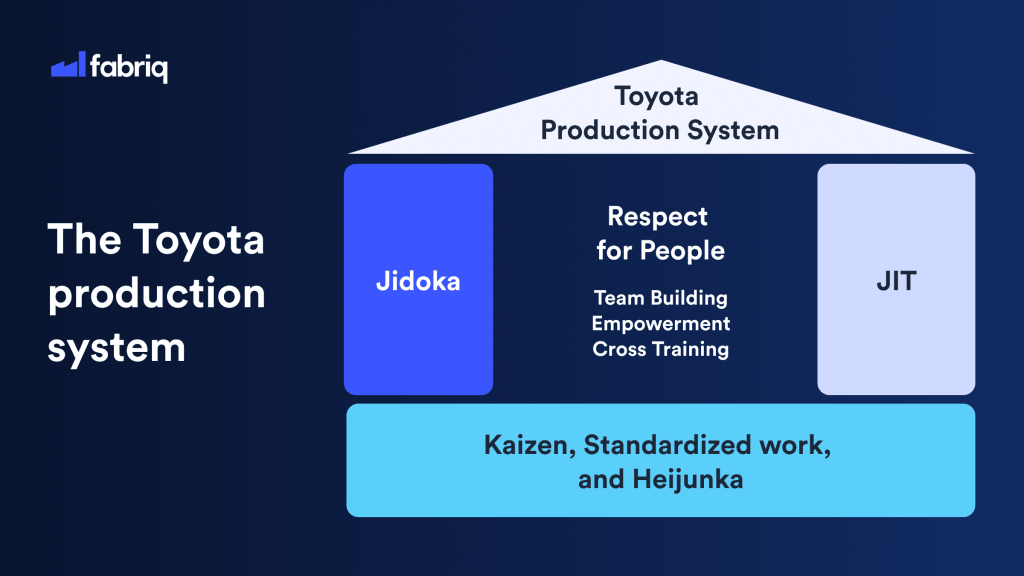
Just in time and jidoka are the two key pillars that support the Toyota production system:
Just in Time (JIT)
It is the principle that focuses on producing only what’s necessary, when it’s demanded, and in the specific quantity required. The JIT approach reduces the need to maintain a lot of excess inventory. Naturally, it slashes storage costs. JIT also makes sure that production is in close alignment with customer demand.
Chief JIT components include:
- Takt time, which defines the production pace
- Pull-based systems that address real demand
- Kanban system, which indicates when products or materials are required
Implementing JIT allows you to keep waste to a minimum, enhance efficiency, and make manufacturing processes smoother.
Jidoka
Jidoka is about lending a human touch to automation. It focuses on weaving quality into the process of production. So, how does it show up in a TPS environment?
When a problem crops up, operators and machines are empowered to halt production. This ensures that issues are resolved promptly and keeps defects from heading downstream and amplifying. Here are some essential aspects of Jidoka:
- Abnormalities are detected automatically
- Defective processes are stopped immediately
- Root causes are analyzed and corrective actions undertaken
Jidoka and JIT, when paired, help develop a balanced system that considers both quality and efficiency as priorities.
Key Principles behind the Toyota Production System
The following key principles guide the Toyota production system and also shape the way in which many organizations operate today:
Reduction of Waste
Waste elimination is at the core of TPS. And any activity that doesn’t offer any value-addition for the customer is deemed as waste. Some common waste types are waiting, overproduction, excess inventory, defects, and unnecessary movements. Reducing waste can help you make operations more streamlined and boost production efficiency.
Kaizen or Continuous Improvement
Making small improvements to processes on an ongoing basis is what kaizen is about. Instead of waiting for substantial changes, in a TPS environment, teams identify and carry out incremental improvement every day. It becomes easier to achieve long-term continuous improvement with this approach. Also, organizations can adapt to evolving conditions more easily and without putting in a lot of effort suddenly.
Standardized Work
Standardization helps you ensure that processes are carried out efficiently as well as consistently. When best practices are defined well, you can reduce variations and uncertainty. Product quality gets better as a result and a stable foundation is also created for future improvements. This is especially important if you are running multiple sites.
Continuous Flow
If you are looking to minimize inefficiencies and delays, it’s critical to maintain a smooth continuous flow manufacturing. Simply put, products need to move through different stages of production seamlessly, so lead time is reduced. It can not only help you meet customer needs quickly but also lower overall costs and strengthen the bottom line.
Respect for People
In a TPS environment, it’s widely recognized that frontline workers are instrumental to success. They are trained to spot problems proactively and encouraged to share ideas or suggestions without any fear or hesitation. This fosters a collaborative atmosphere where workers actively participate in improvement efforts. Naturally, innovation can thrive more easily.
6 Benefits of the Toyota Production System
The Toyota production system offers manufacturing companies both strategic and operational perks. Here are the key ones:
1. Better Production Efficiency
With TPS, it’s possible to streamline workflows and get rid of steps that aren’t required. This makes the entire production process more efficient. Processes become faster and you get more done in less time. It’s easier to manage processes too as they are predictable.
In case you operate across multiple plants, TPS helps reduce productivity losses and ensures predictable outputs across different locations. You can also utilize capacities better, balance workloads, and minimize variability across sites. No single plant will turn into a bottleneck this way.
2. Less Waste
Through waste reduction, you can improve the way raw materials are utilized and control costs better. Eliminating redundant activities, keeping defects to a minimum, and reducing excess inventory are some key strategies in this regard.
Overall profitability from less waste can especially improve for multi-site operations. You can minimize unnecessary movements and handling in between plants besides taking the above steps. When every plant reduces waste, the overall production network becomes more cost-effective and leaner.
3. Improved Product Quality
The identification and resolution of quality issues becomes an immediate affair with the jidoka principle. Hence, final goods have fewer defects and this leads to greater customer satisfaction. Your brand reputation improves and so does repeat and new business.
TPS helps keep quality consistent across multiple facilities too. Hence, regardless of production location, product quality gets better and there are fewer reworks or recalls. You get to meet global standards with more ease.
4. Swifter Response to Customer Demand
JIT helps you adjust to customer demand changes fast and more effectively. And this benefit particularly becomes evident when you are operating across multiple sites and serving customers with varied demands in different regions.
When you align output closely with real-time demand, you can respond swiftly to regional market changes and reduce lead times. In industries where demand is tricky to predict or customer preferences evolve rapidly, this flexibility goes a long way.
5. Better Employee Engagement
Since Toyota production system encourages employees to contribute to continuous improvement efforts, they develop a stronger sense of ownership and accountability. In case of multi-site operations, TPS also helps improve collaboration and exchange of ideas across locations. It becomes easier to sustain continuous improvement over time.
6. Enhanced Process Visibility
Visual management tools and Kanban system offer clearer insights into production processes. This enhanced visibility allows your teams to spot bottlenecks and make improvements where necessary. And if you have multiple facilities to run, TPS helps improve transparency across locations.
Besides greater clarity on production status and inventory levels, you can ensure better coordination across plants. Decision-making will become more strategic as well.
Why TPS Matters More Than Ever for Manufacturers
Since the principles driving TPS deal with fundamental manufacturing-related challenges, they have passed the test of time with flying colors. After all, TPS helps you operate more flexibly, respond to changes quickly, and improve operations constantly. However, you also need digital capabilities to make the most of the Toyota production system.
Fabriq, for instance, helps transform team coordination, visibility maintenance, and the sustenance of improvement efforts even in complex environments. You can track performance in real time, solve problems in a collaborative fashion, and implement jidoka, JIT, and kaizen practices at scale. You will be better positioned to achieve resilience, production efficiency, and operational excellence.
Request a Demo.
